Pain Library/Sciatica

Pain Library

Sciatica. Treatable.

Sciatica — pain that radiates from the lower back down one or both legs — affects up to 40% of people at some point. Most cases resolve with the right approach. Here is what works.

Person lying on back performing supine piriformis figure-four stretch on a mat

Quick facts

  • Sciatica is a symptom, not a diagnosis — it describes nerve pain along the sciatic nerve
  • The most common cause is a lumbar disc herniation pressing on a nerve root
  • Up to 90% of cases resolve without surgery within 6 to 12 weeks

Pain Library

Understanding sciatica

Sciatica describes pain that travels along the path of the sciatic nerve — from the lower back through the hip and buttock, down the leg. It typically affects one side of the body and can range from a mild ache to a sharp, burning sensation.

The most common cause is a herniated disc in the lumbar spine pressing on a nerve root. Other causes include spinal stenosis, piriformis syndrome, and — rarely — tumors or infections. A proper assessment is important to identify the cause.

The vast majority of sciatica cases improve with conservative management. Exercise, manual therapy, and pain education are the cornerstones of treatment. Surgery is rarely necessary and is reserved for cases with severe neurological deficits or failure of conservative care.

Important: Seek urgent care if you experience: loss of bladder or bowel control, progressive leg weakness, or numbness in the groin or inner thighs (saddle anesthesia). These may indicate cauda equina syndrome, a medical emergency.

NASM-based corrective exercises

Movements that help.

  • Lengthen — Nerve Mobility

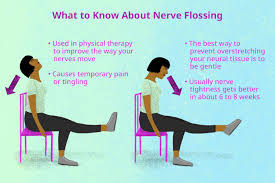
    Sciatic Nerve Floss

    Neural mobilization is a key NASM corrective technique for reducing neural tension along the sciatic pathway. The seated nerve floss gently mobilizes the nerve through its full length, reducing mechanosensitivity and improving neural glide without loading the lumbar spine.

    • Sit upright in a chair with feet flat on the floor and good posture
    • Slowly extend one knee to straighten the leg while simultaneously pointing the foot up (dorsiflexion)
    • Hold 2 seconds at full extension, then return the foot and knee to the starting position
    • 10 repetitions per side — perform 2 to 3 times daily, staying within a tolerable range
    See full exercise guide
  • Inhibit & Lengthen — Piriformis

    Supine Piriformis Stretch

    The piriformis is a common overactive muscle in sciatica presentations. NASM corrective protocol calls for inhibiting and lengthening this muscle before activating the underactive hip stabilizers. The supine figure-4 stretch is the most accessible and effective technique.

    • Lie on your back with both knees bent and feet flat on the floor
    • Cross the affected leg over the opposite knee, forming a figure-4 shape
    • Gently pull the uncrossed leg toward your chest until you feel a stretch deep in the buttock
    • Hold 30 seconds, 3 repetitions per side — perform daily
    See full exercise guide
  • Activate — Lumbar Stabilization

    McKenzie Press-Up Extension

    The McKenzie Method is widely used by physical therapists to centralize disc-related sciatic pain. Repeated lumbar extension in prone (press-up) can shift disc material away from the nerve root, reducing leg pain. Most effective when symptoms are worse with forward bending.

    • Lie face down on a firm surface with your hands positioned under your shoulders
    • Keeping your hips on the floor, press up through your arms to extend the lower back
    • Extend as far as comfortable — stop immediately if leg pain increases or travels further down
    • 10 repetitions, 3 to 4 times daily — perform at the first sign of increased leg symptoms
    See full exercise guide

Physical therapy equipment

Tools that support your recovery

Affiliate disclosure: links below go to Amazon. If you purchase through them, we may earn a small commission at no extra cost to you. We only recommend equipment used in physical therapy practice.

Pressure Relief$25 – $55

Coccyx Seat Cushion

Orthopedic seat cushion with coccyx cutout. Reduces direct pressure on the sciatic nerve during prolonged sitting — a key aggravating factor for piriformis syndrome and disc-related sciatica.

Why it helps: Offloads the piriformis and ischial tuberosity, reducing sciatic nerve compression at the source.

Flexibility & Mobility$8 – $20

Piriformis Stretching Strap

Yoga strap or stretching belt for assisted piriformis and hamstring stretches. Allows deeper, more controlled stretching without straining the lower back.

Why it helps: Enables the supine piriformis and nerve floss stretches to be performed with proper form and controlled depth.

Pain Management$25 – $60

Heating Pad (Electric)

Moist heat electric heating pad for the lower back and glutes. Heat increases tissue extensibility before stretching and reduces muscle guarding around the sciatic nerve.

Why it helps: Prepares the piriformis and lumbar muscles for corrective stretching by increasing blood flow and reducing spasm.

Self-Myofascial Release$15 – $35

Foam Roller (Targeted)

Textured foam roller or massage ball for piriformis and glute SMR. Rolling the piriformis before stretching is the NASM-recommended inhibition step for sciatica presentations.

Why it helps: Reduces piriformis hypertonicity before nerve floss and stretching exercises, improving their effectiveness.

Common questions

Common questions.

Answers to the questions we hear most often about sciatica.

  • Most acute sciatica episodes improve significantly within 4 to 8 weeks with conservative management. Around 90% of people recover without surgery within 6 to 12 weeks. Chronic sciatica (lasting more than 12 weeks) is less common but responds well to a combination of exercise, manual therapy, and pain education.

  • Yes — for most people, walking is one of the best things you can do. It promotes circulation, reduces nerve sensitization, and prevents the deconditioning that comes with inactivity. Start with short, comfortable distances and gradually increase. Stop if walking significantly worsens your leg pain.

    If walking increases your leg pain significantly, try shorter distances or a flatter surface. Consult a physical therapist if pain persists.
  • Surgery is rarely necessary. Most cases resolve with conservative management. Surgery may be considered if: you have severe or progressive neurological deficits (leg weakness, foot drop), you have cauda equina syndrome, or you have failed 6 to 12 weeks of appropriate conservative treatment. Discuss the risks and benefits carefully with a spine specialist.

  • Common aggravating factors include: prolonged sitting (especially on hard surfaces), bending forward, coughing or sneezing, and activities that increase intra-abdominal pressure. Identifying your specific aggravating and relieving positions is an important part of self-management — a physical therapist can help with this.

Have a question we have not answered? We read every message.

Ask a question
Next steps

Start your recovery.

Browse our full library of condition guides, or read the latest evidence-based articles on nerve pain and recovery.

Medical disclaimer: The information on this page is for educational purposes only and is not a substitute for professional medical advice, diagnosis, or treatment. Always consult a qualified healthcare provider before starting any exercise program, particularly if you have a medical condition or have recently been injured. Read our full disclaimer.